There has been a lot of talk about how disappointing the Chicago Blackhawks have been this season. At the time of writing the Blackhawks have a 5-13-1 record in their first 19 games of the 2026-27 NHL season. Only the Vancouver Canucks have a worse record.
My question is, should anyone be surprised? I have written on HockeyAnalysis.com (here and here for example) and on various social media platforms (here, here and here for example) that rebuilds take a long time and that the NHL is not a young players league. Young teams simply don’t win in the NHL and the Chicago Blackhawks are a very very young team. A significant portion of their roster is under 23 years old. In the NHL that is not a recipe for success.
Let me step back for a minute and look at how age correlates with team success. I looked at the past 10 seasons and grouped teams into four groups.
- Final Four playoff teams
- Other Playoff Teams
- Other non-Playoff Teams
- Bottom 5 regular season teams
I then looked at how each team group allocated regular season ice time (all situations, skaters only) to age groups. I used rolling 3-year ages to define the age groups (i.e. 18-20, 19-21, 20-22,…,37-39. 38+). Using rolling 3-year age groups helped smooth the curve when plotting. Age was the players age on January 1st of the season in question. Here are the results.
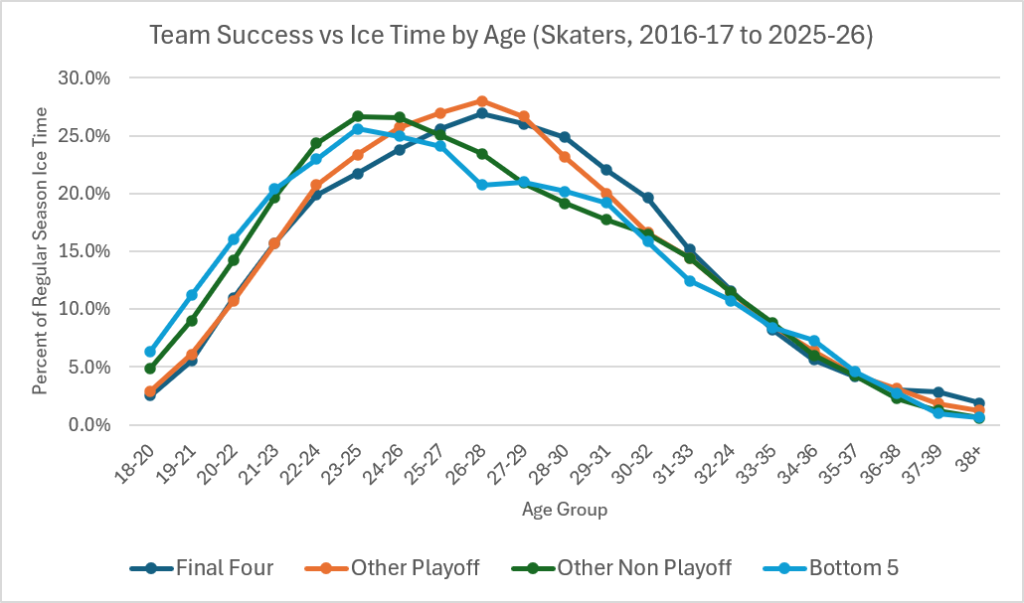
On average, bottom 5 teams allocate the more ice time to players 23 and under than other non playoff or playoff teams do. Non playoff teams have their allocation of ice time peak for players aged 23-25 while playoff teams had their allocation of icer time peak for players aged 26-28. Teams that reached the final four on average allocated more ice time to players aged 28-33 than other team groups and also allocated more ice time to aging veterans aged 37 and older.
It is pretty clear, older teams tend to do better while younger teams with more players aged 24 and younger struggle.
Now, let me throw 2026-27 Chicago Blackhawks into the mix.
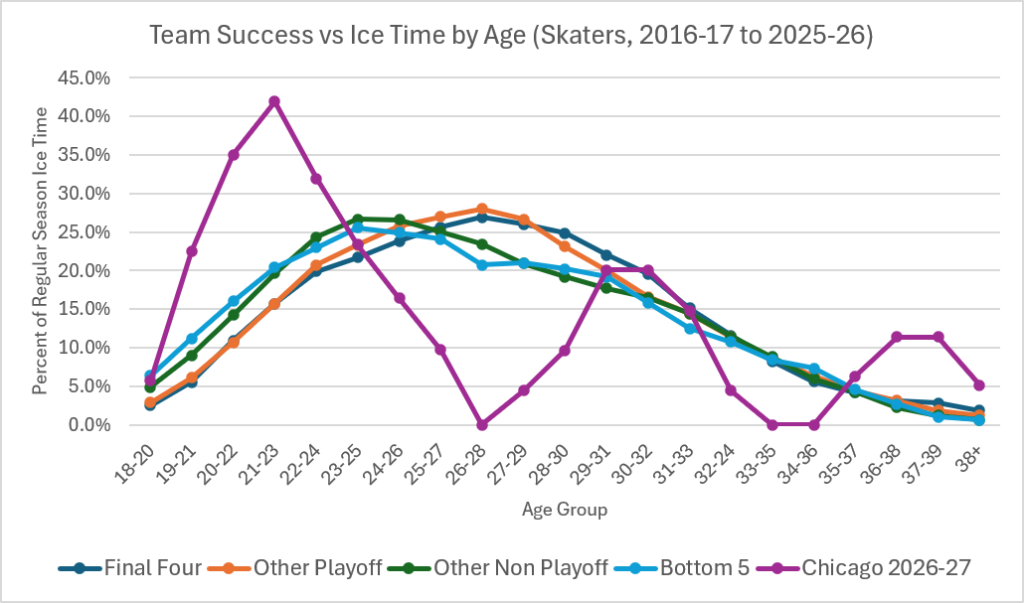
Wow! Over 40% of Chicago’s ice time this season is allocated to players aged 21-23 and none is allocated to players aged 26-28. As a reminder, playoff teams on average allocated more ice time to players aged 26-28 than any other age grouping. Chicago has no such players on their roster.
Final four teams (50.5%) and other playoff teams (50.1%) have on average ~50% of their ice time allocated to players aged 25-30. Non playoff teams (44.2%) and bottom 5 teams (44.3%) have on average ~44% of their ice time allocated to players aged 25-30. The 2026-27 Chicago Blackhawks have a mere 19.4% of their ice time allocated to players aged 25-30. While I would never say it is impossible to be a playoff contending team with only 20% of your roster in what I would call their prime years, it really does make the challenge far more difficult and probably not something we should expect.
The reality is, Chicago is a very young team. Probably one of the youngest teams ever to dress in the NHL. The 2026-27 Chicago Blackhawks have allocated 54.4% of their ice time to players aged 24 and younger while playoff teams average closer to ~26% of their ice time for 24 and younger players. Their window for Chicago to start contending for the playoffs is probably 2-3 years away. Their window to compete for the Stanley Cup is probably 5-8 years away. That is when their current crop of 21-25 year old players are aged 26-30. Any trades or roster moves the team might be considering right now must keep that window in mind. You simply cannot trade prospects and picks for any player that won’t be making contributions to the roster during the Stanley Cup window years. That’s how you become the Toronto Maple Leafs whose impatience closed their Cup contending window before it really opened.
Tear it down rebuilds take a long long time. It is still early(ish) in the process for Chicago. Patience is key.